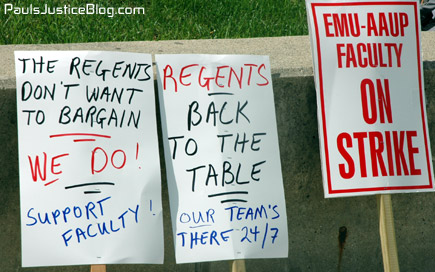
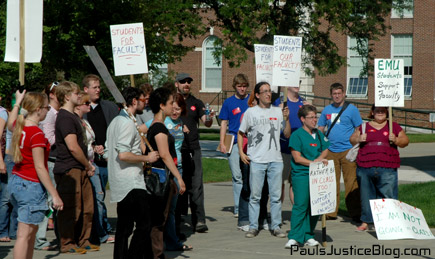
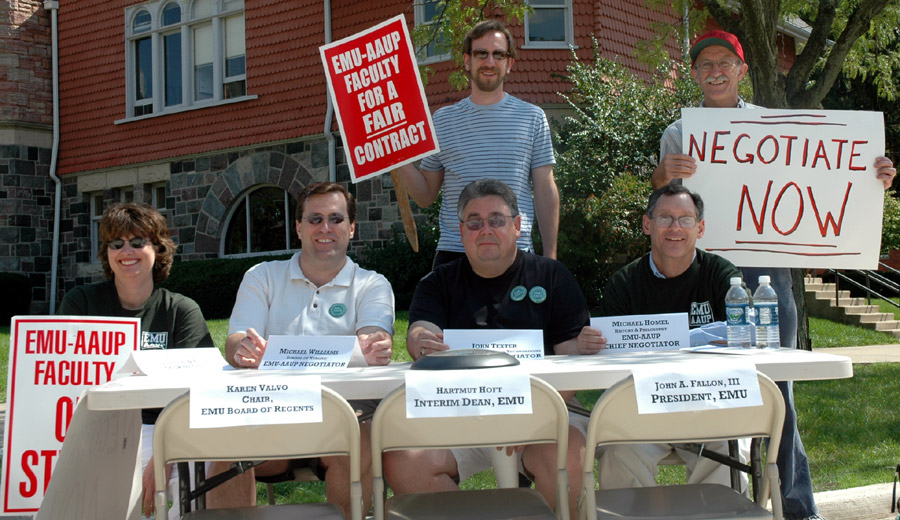
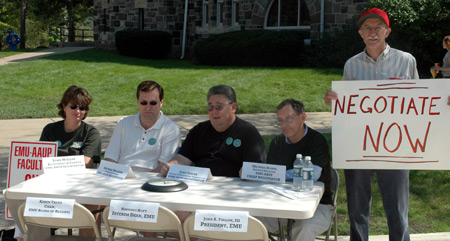
« On Strike for Labor Day (Part 11) | Main

September 16, 2006

On Strike for Labor Day (Part 12)

In the last post, the administration was negotiating again, and we were about 20 hours into the session. Our team was waiting for a final offer to take back to the faculty.

The offer that came through was poor. More accurately, it was the same poor offer they put on the table on Sept 5 before they walked out. Basically, they spent more than 20 hours repackaging it and trying to dress it up. But shifting money from one category to the other (or from one pocket to another in the same pair of your jeans) doesn't change anything, even though it the final offer might make for a better press release.

We left the table about 5:30am after starting at 9:30am the previous day. The total increase int he administration's offer was about $20,000, which you'd need to spread across 650 faculty members over 3 years. (And you thought I was exaggerating they they just shifted it around!)

By the time we broke down the room, the 6am faculty vigil was starting. As exhausted as I was, it was actually nice to see people there, to go and talk and share some of the experience. But after 30 or 45 minutes, I had to go home and crash and before the noon faculty meeting where we'd get a sense fo the group on what to do next.
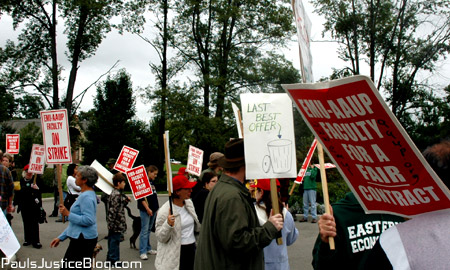
reject last best offer

I love the 'last best offer' and garbage can! From the picketing in front of the President's house last week 

To no one's suprise, the overwhelming sentiment was to reject the administration's offer. The quention was whether to return to strike or seek fact-finding under the state labor law. For the good of the students and university, we chose the latter path. This involves both sides submitting reports to a neutral party, who will then make recommendations on how to resolve the dispute. It's advisory, and we fully expect that the administration will ignore recommendations favorable to us. Obviously, that wouldn't be good, and a part of our strategy will be to put pressure on them to accept the recommendations in their entirety.

Because this process can take from two to six months, this series will continue as we wind through the process. I do intend to use the blog for other topics in between. But having started this account, it makes sense to follow the story through to the end. (I'll try to make a link or page that collects all the various parts for easy reference.)

For the mement, we're organizing for the next stages: getting the report ready, an organizing committee, and a communications committee that I'll be pulling together. So far we have a number of enthusiastic volunteers. While that's good for us, it's also bad in that many faculty have seen the dark side of the administration: they've seen the stonewalling, the screwed up press releases trying to paint us in a bad light, and the final day of bargaining wasting our time.

Worse still, it's sinking in that they have hired a high-priced law firm to run negotiations and keep us from making gains, a high-priced lansing lobbying/PR firm to make faculty look bad, and now they'll be hiring another outside firm to do the fact-finding report.  Seems pretty obvious they spent more trying to keep us down than what it would have cost to just settle the contract and give us a pay increase consistent with the average in the state. That's all we wanted. And they say the respect us, but they'd rather pay more to people keep an average settlement from us and make us look bad for asking.

president fallon - respect faculty!!

They probably still don't understand it's about respect. Sigh. From picketing in front of President Fallon's house last week.  

We have some key questions about how this will play out - what kind of attitude will the faculty have down the road? Will it be a return to normal, or will the frustration, anger and disappointment at the administration continue? We also have some questions about how the fact-finding process will unfold that I'll have to write about. Plus, I need to debrief on some topics I on which I had to be silent earlier. 

Meanwhile, it does seem funny to be back to a more regular life and all the hours of stress, strategy and negotiations. I think the trick will be to quickly move forward with the next phase. So far, we have put up a good fight against an adminsitration more determined than we imagined to screw us. We maintained a strike for 11 days, and faculty were getting up at 4:30am to jump in front of trucks to stop deliveries.  After nine days of strike and picketing, more than 125 showed up to picket the President's house on a Sunday afternoon. We didn't get the contract we wanted - yet! - but they didn't break the union, we didn't self-destruct, and we've emerged through an intense labor strife with a high degree of solidarity and commitement to move forward.

So, the story - and the fight - ain't over. Stay tuned.  
« On Strike for Labor Day (Part 11) | Main

« On Strike for Labor Day (Part 10) | Main | On Strike for Labor Day (Part 12) »

September 12, 2006

On Strike for Labor Day (Part 11)

It's going on 1am and we've been negotiating since 9:30 am. No end in sight at the moment.

Since my last post, the big change in the status of our labor dispute is that we are actually negotiating again. Remember the administration walked out on Sept 5, and after a few days where both sides had no direct contact, on Sunday we started some direct off the record conversations about how to get back to negotiating.

When I say 'some conversations,' it really understates the intensity of the effort. We put together a number of ideas about conditions under which both sides would return, prioritized them, and of course tried to balance that against what we were achieving and risking through a prolonged strike.

After negotiating most of the day Sunday and all day Monday, we achieved a 7 paragraph  memorandum of understanding about suspending the strike for 24 hours in order to negotiate some more. Then, we spent two hours negotiating where to meet. (No shit) We started that time period at 9:30am.

Of course, if it takes 2 hours to negotiate a place - with some seriously intense conversation and raised voices - figuring out health care and compensation isn't going to be easy. [If I was more awake, I'd figure out an appropriate comment about new insights into Mid East problems.]

Today has been

tensions, tension, anger, anger, tension, boredom, boredom, boredom, tension, anger, anger, tension, boredom, tension, boredom, boredom, etc

A not so careful read reveals there's no joy or happiness - not even satisfaction or relief. Of course at 1:30am, it's still on the early side. I'm not especially optimistic, but I also know that one tactic is to induce frustration and despair on the other side, so small movement is more warmly received. But several of have been here before, and we're more on the annoyed side than the desperate side.

But we are setting up an interesting day tomorrow today, with a faculty meeting at noon. We'll have to make some decisions that will include the option of returning to a strike. You'll hate me, but I'll have to leave that as the cliff-hanger, so you'll stop back for Part 12.

For further reading, check out Cary Nelson's piece "Solidarity" in Inside Higher Ed. He's the Predsident of the national AAUP, and he was out here earlier for a few days. (Scroll back a few posts) Here's a meaty excerpt:

What I had not calculated was how an extraordinary level of faculty solidarity would mesh with new technology. My previous experience with multiple picket sites had involved quite a bit of sending messengers running back and forth across campus. Now there were people with cell phones at every site. This was especially helpful when particular locations required additional troops, as when people needed to work at turning away delivery trucks. On one occasion I persuaded a Teamster member delivering hamburger buns to call his office, which agreed to cancel the rest of the week’s deliveries. At a major university construction site, the concrete trucks had nonunion drivers. A cell phone call reached the concrete supplier, whose union loaders agreed not to load more concrete trucks. Other activists were taking cell phone messages in their cars and delivering water, picket signs, and modest edible treats as needed. Several retired professors took particular pleasure in running these on-demand delivery services.

I spent several hours on Tuesday morning visiting picket sites, introducing myself and talking with faculty, students, and university workers. The faculty were unvaryingly determined, though also anxious. False rumors abounded, as usual, but cell phone calls kept them under control. I hadn’t thought of cell phones as rumor control devices, but they enable members involved in job actions to make rapid contact with the leadership. The deeper anxiety was centered on the disruption of their faculty identities. They wanted to meet their classes on Wednesday. Most simply asked to be treated the same way other Michigan employees were being treated. A few said they’d settle for any offer that wasn’t blatantly insulting. But because they were faculty they could not just picket; they had to talk these issues through. Happily, it was a bright Midwestern day. Spirits overall were more than high; they were stratospheric. Professors of English and engineering were one; they had shed their disciplinary skins. They were now part of that universal faculty that now and again focuses on their common destiny and mission.

At lunch time I made my way back to the negotiating room where I had first arrived the day before. It was a busy space. The union had been asking the administration for health care statistics for a year to no avail. Suddenly, at the penultimate moment, the data had arrived. Ordinarily this would have been a disaster. In the past, interpreting the numbers with sufficient mastery so as to suggest alternative solutions would have taken weeks. But the chapter president is a business faculty member more than comfortable with spread sheets. What’s more, the days of the smoke filled bargaining hall had long disappeared. Each member of the bargaining team sat in front of a computer. A ten foot high projection screen let everyone see spreadsheet proposals.

Meanwhile it had been decided that a large campus auditorium was the right place to meet. PowerPoint demonstrations were being prepared. E-mail messages went out to faculty. A phone tree got to work. An hour later we walked into an auditorium packed with hundreds of faculty. Scores of red AAUP caps dotted the room. There was applause, laughter, cheers, and pointed questioning, all echoing sharply against brick walls. My own presentation was easy. I assured everyone of continuing support from the national AAUP, and I emphasized that they were not fighting for their own interests alone. A highly conservative governing board was seeking to deny faculty any influence over their terms of employment or working conditions. This was a battle we needed to win for the country as a whole. Over 40 years in the academy I have never seen a faculty so unified and determined. It was astonishing and exhilarating. Certainly the administration had a hand in inadvertently unifying the faculty. But constant communication between the leadership and the members helped turn anger into collective action.

The overwhelming majority of faculty contracts are, of course, negotiated without a strike. Both parties ordinarily prefer a solution and, despite competing financial aims, are willing to work toward one. The Eastern Michigan administration’s determination to break the faculty’s will is not unprecedented but surely atypical.

Boredom, tension, boredom, boredom, time for more coffee.

[UPDATE: boredom, boredom, boredom]

[UPDATE 2: boredom, fatigue, weariness, boredom]

Start 9:30am

now 1:50am  2:10am  2:30am  3:20am  3:44am  3:58  4:20am

Finish??? 

« On Strike for Labor Day (Part 10) | Main | On Strike for Labor Day (Part 12) »

« On Strike for Labor Day (Part 9) | Main | On Strike for Labor Day (Part 11) »

September 10, 2006

On Strike for Labor Day (Part 10)

Life has been exceedingly busy, although the basic situation has not changed. The administration walked out of contract negotiations Sept 5 and refuses to talk with us while we're on strike. We don't want to call of strike. Conversations are difficult with those positions.

I've been busy with some special projects. Saturday was a crash course in drupal to get ready for the online petition we've created. If you didn't see it on our website, please consider adding your signature. We tried to keep it simple:

Because talks were progressing with the faculty union, you should not have walked out on the collective bargaining process. You need to resume talks, respond to the faculty union's last proposal, and finish negotiating the last several issues.

The administration should be trying harder to negotiate rather than impose a contract on faculty. Do the right thing so classes can finally start.  

Once again, you can add your signature by clicking this link [link removed now that the petition is down]. It opens in a new window, so if you're not sure, you can read the other parts of this series and then sign the petition.  

The ad for the Ann Arbor news came out Sunday morning and will run again Monday, along with an ad in the Detroit Free Press. The latter has had it's own share of labor problems, so they have pretty much reported what has been in the administration's press releases. Their editorial wasn't very favorable to us, but they were quite willing to take our $.

The ad for the AA news basically looked like:

EMU-AAUP faculty negotiating team ready to finish discussing the contract, but the administration walked out of talks, stopping the collective bargaining process.

Eastern Michigan University Faculty

- Ready and willing to negotiate

- Wants to be teaching students

- Offered to submit to binding arbitration

- Believes in bargaining to a mutually acceptable result and refuses to have a contract imposed on them

For more information: http://www.emu-aaup.org

 
Not bad for short notice, I hope. Some of the media buys are difficult because of the lead time papers typically want. If you need 3 - 4  days, then do we make the buy (pay at time of placement) and assume the strike is on? As it turned out, there was some room available on shorter notice that we took, so we had a few hours to get the ad and photo together.
 
Today we demonstrated at University House, although the president was conveniently not in. I'll have pictures tomorrow, but there were about 150 faculty there at the peak and 200 over the several hours the demonstration went on. Given that we have about 670 faculty, that's impressive - especially since we've all been demonstrating and picketing frequently since Sept 1 when the strike.
 
What's also great to see is groups of faculty starting to come together to think about creative ideas. The grasssroots is working now, and pulling together their own ideas and projects. Even as some will no doubt wander back into the classroom Monday and next week, others are energized. Open source activism - gotta love it.  
 
Obviously this next week is the breaking point. One side will need to give, or we'll both find a compromise to end this and get back to business.  At some point, there's going to be some serious developments. It's difficult to see past On Strike for Labor Day (Part 15), although I'll confess that I never imagined it would get to part 10.
 
In the meantime, I need to go to bed. But a few snippets:
 
From the Moving Ideas Blog

The right of faculty union to negotiate for its contract is as important as any union's right to do so. And the thought that the administration walked out without responding to the faculty's proposal is disturbing.

This country is great because it was designed to make policy deliberatively. Whether in Congress or at the contract negotiating table, if there is no discussion and working together to solve problems there is little hope for an equitable solution.

To view the EMU AAUP's petition, visit: [link removed and petition down].

EMU student newspaper editorial: Faculty Union Has Right to Strike 

America has long had an ambiguous relationship with labor. While we celebrate it with a long weekend, that holiday was shifted by five months in order to avoid recalling the Haymarket riots that precipitated it. While eight-hour days and overtime pay are an entitlement for most workers, the unions that achieved those victories are deemphasized even as those protections are eroded.

And when regarding labor disputes, much of America sympathizes with the owners and management even as concessions wrung from unions undermine the wages and protections of average Americans. Too often, the concern is more the inconvenience of a delayed flight or a missed class than solidarity.

The administration has negotiated in bad faith, walking away from the bargaining table before the start of classes. The administration has refused to seriously consider the position of the faculty. Furthermore, the administration has misrepresented and sought to cloud the issues surrounding the strike, polarizing the students against the faculty.

While the administration charges that the faculty strike is illegal, it is important to consider this in the political context of labor relations. Under Governor Engler, state employees were barred from striking, a move intended to bust teachers' unions. But we should all remember that illegal does not equal immoral, and that the administration's moral arguments are virtually non-existent.

The morality of striking, even though it inconveniences students, is founded in the belief of freedom of association and in the belief that capitalism is best served by allowing groups to exercise their power collectively. While it may be illegal, in this case the law is against justice.

Nicely said. The rest is also good and it was difficult not to reproduce the whole piece here, but It's worth the read.  

We also got a mention in the AFL-CIO blog. It's mostly just a mention of this blog, but people interested in this issue may like to check out the labor blog.  
 

« On Strike for Labor Day (Part 9) | Main | On Strike for Labor Day (Part 11) »

« On Strike for Labor Day (Part 8) | Main | On Strike for Labor Day (Part 10) »

September 08, 2006

On Strike for Labor Day (Part 9)

Please see On Strike for Labor Day? Part 1, Part 2, Part 3, Part 4, Part 5, Part 6, Part 7, Part 8 and additional background

Another day with no negotiations and no word from the administration about resuming contract talks. Still, it was a very busy day around the office.

back to the table to negotiate 

Much of what we're doing now revolves around multiple levels of strategy. Obviously much of this can't be disclosed here, but there are many short-term and longer terms (days ahead) to deal with. Most immediately is getting information produced: deciding on information for the daily flyers, and getting the paper, refreshments, and stickes (I Support My Faculty) up to compus in the right places.

When students moved in, we distributed thousands of flyers to get information to them early. We're still working on that, but fighting the problem that students go to EMU's website for information, because that's where they get email, register, etc. The administration also has access to listserves that we don't. We do get CCed on some very funny emails from students pushing back:

EMU can go piss up a rope with that "illegal strike" stuff, and ought better do some things at the bargaining table to reach an agreement with the professors, in order that the AAUP leadership may have a package worthy of recommending to their membership It's called "good faith bargaining", and that's what it takes to avoid labor disputes.  (I note EMU's record along these lines in past contracts is at best middling, often poor.) 


Your sending out an email of such tone to students like me serves no good purpose.  Be assured I'm never to show up for classes being run by rat instructors.  There are plenty of others like me too .... this is Michigan, and we're freedom-loving folks who believe in a fair day's pay for our work.  Get with what matters !  Helps reach an agreement, and enough with the mass Emails ....   


[Clarification: a sharp former student and now lecturer took the 'rat' comment to be bashing lecturers and adjuncts, and thus anti-feminist because women are more likely to hold those positions than tenure-track or tenured jobs. I'm not sure what the student meant, but I certainly don't regard the lecturers, grad students or contingent labor who taught to be rats or scabs; that term would be reserved for anyone who took the jobs or did the work of striking faculty and thus undermined the strike.]

And another (with a reference to a strike by public employees is prohibited under Michigan law):

The right to assemble and unionize is a civil right and a human right. It is Michigan's law that is illegal under US Constitutional law. Shame on you for sending these ridiculous emails. Stop sending propaganda and get back to the bargaining table with EMU-AAUP.
Well said. Thanks.

student rally to support striking faculty 

Obviously the larger issues deal with the strategy of getting back to the table to finish negotiating. We're exploring a number of avenues here that we'll talk about at the all faculty meeting later today. We're also trying to map out a range of options they might pursue, and developing our responses so we're ready to go. I realize that sounds vague and I apologize, but I think you can understand.

Part of what I can say is that our offer of binding arbitration was rejected, but they returned to offer fact-finding (which we knew was coming). To enter fact-finding, we would need to call off the strike, then the recommendation is advisory. So fact-finding would likely entail: calling off the strike, months of hearings, a recommendation the university would likely ignore or adopt small parts while they try to get us to accept the offer they had on the table last week. Returning to strike in December isn't really an option, so guess what happens?

We're returning an offer of binding fact-finding, which is also available under the state's labor law. We're willing to submit this to a binding decision by a neutral third party. Do you think they are? 

More generally, we are in touch with the lawyers, and frequent communication with the national AAUP. They have been amazingly supportive. There are not too many strikes in higher education, and the kind of walk out done here is unusal, although not unheard of). They're keeping a close on us and obviously want to make sure this doesn't become a trend.

I've heard a few comments from faculty about the involvement of the national AAUP. Let's be clear that they are giving advice and are very respcectful that it's ultimately our choice about what to do with it. They don't have a vote and would go withdraw if we wanted, but they have given great advice and we would be in a much more dire situation if it were not for their help.  

Some faculty are understandably nervous about being out on strike and rumors of the dire consequences circulate. But all the worst case scenarios are far-fetched. The practical impediments are great, and we have a number of promises of support in the unlikely case they materialize. Many of these would also make the university look bad, would hurt recruiting of new faculty and risk inflaming more people than they frighten.

Off to strategize and meet with faculty.  

« On Strike for Labor Day (Part 8) | Main | On Strike for Labor Day (Part 10) »

« On Strike for Labor Day (Part 7) | Main | On Strike for Labor Day (Part 9) »

September 07, 2006

On Strike for Labor Day (Part 8)

Please see On Strike for Labor Day? Part 1, Part 2, Part 3, Part 4, Part 5, Part 6, Part 7 and additional background

After so many days at in the basement negotiating, today was a radical change of pace. No negotiations after the administration walked out, and the negotiating team got to enjoy the sunny day

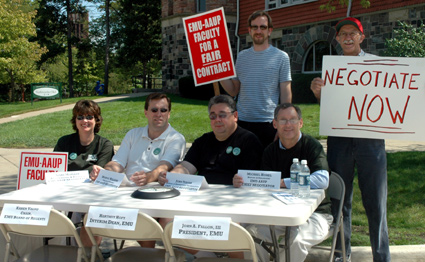
EMU-aaup negotating team waits after administration walks away from talks 

EMU-AAUP negotiating team ready to finish negotiating the contract whenever management wants to return from the walkout

So at the moment, there are no negotiations and no scheduled negotiations. The only contact we had with the administration today was when we offered to call of the strike and return to class if they agreed to submit to binding arbitration. It took them not more than a few hours to send back a letter saying saying 'no.'

Meanwhile, their outside PR firm was at work.  As I mentioned in a previous post, they have hired an expensive Lansing PR firm to replace their own office of Public Communication. One recent press release stated that we walked away from a 16% increase in wages and benefits. I hope everyone is smart enough to know that there must be something wrong with this.

The 16% comes from adding the pay increases for all 5 years of the contract. There's also a 1% increase to the contribution the university makes to our retirement. So 3% for 5 years + 1% retirment = 16%. But, they want us to take a hit on what we contribute to health care that amounts to more than 1.6% in the first year. The 1% contribution to our retirement starts in year 2 of the contract, and phases in at .25% per year. (Amazing they can phase in their contribution to our retirement, but adamantly refused to phase in the increases in health care costs. When they presented the proposal, we joked that we were glad it was not an 8 year contract or that incrase woul dbe 12.5% a year for 8 years.)

What we're really looking at is a net wage increase of less than 1.5 in year 1 and the next 4 years are locked in at a net of about 3.2%. Since inflation this year is 4%, and likely to continue at this pace for the immediate future if the Federal Reserve makes all the right moves, we're looking at a serious erosion in real puchasing power: minus 3.5 year 1 and most likely a negative for the next four years as well.

The second bit of PR spin was an announcement about the deal purporting to show that EMU salaries are average compared to our peers. We KNOW this is not true and have asked for the names of the institutions they regard as our peers, which they will not provide. Suspicious.

In fact, when we did our salary presentation (pdf), we had data from the AAUP and presented on this point. Because there is disagreement about what our group is, we did it 3 ways - all with the same result. When we look at public universities in Michigan, our average is lower. It's the same even when we eliminate U of Michigan, which has substantially higher salaries and may not really be a comparable. We also use the MAC conference as a peer, with the same result (and we note our cost of living here is MUCH higher). The administration also has a peer group they chose several years ago after an extensive analysis, because they wanted to do better benchmarking. Their chosen peer group also shows us below average, and they also have NOT used their own previously selected peer group as the peers for the latest - and more positive - comparison.

While there are other similar points to make about PR spin, there's a larger issue: COLLECTIVE BARGAINING SHOULD BE ABOUT NEGOTIATING TO A MUTUALLY ACCEPTABLE RESULT, NOT IMPOSING A CONTRACT WHEN YOU GET TIRED. They can't just impose a contract  - whatever the terms - because it's less painful than doing it right. They can't just impose a contract because it gives them a better deal than doing it the right way.

negotiating team still waiting 

EMU-AAUP negotiating team bored, but still waiting and ready to finish the contract negotiations

The bargaining process would work best if we could sit down with administration people and talk about issues facing the university and use the opportunity to address some of them. Some issues from both sides get left behind, but in the end there's an agreement we arrived at mutually. The dynamic is different when you have an outside lawyer and outside PR firm working the negotiations to impose a settlement at the end on a schedule and terms convenient to the administration.

Also, if this works, they'll do it again next time - most likely with worse terms for us. If they are willing to impose a contract, what will they be willing to impose in the meantime? The university president appointed the Provost- the top academic official - without any formal faculty input or consultation. What else around the university will happen by fiat rather than as a result of the shared governance their propaganda mission and vision statement says are so cherished?  

This is

  • wrong as far as collective bargaining goes
  • harmful to the already bad labor-management dynamic here. Personally, I'll have a really bad attitude that will continue for a while. It will worsen every time I hear about the 'university community' and all the vale of shared governance
  • sets a bad precedent for future negotiaions
  • sets a bad precedent for more administrative fiats in the years before the next contract

More on these ideas soon.

More info at EMU-AAUP website. Our chief negotiator also maintains a blog with more specific information about the negotiations and issues.

« On Strike for Labor Day (Part 7) | Main | On Strike for Labor Day (Part 9) »

« On Strike for Labor Day (Part 6) | Main | On Strike for Labor Day (Part 8) »

September 06, 2006

On Strike for Labor Day (Part 7)

Please see On Strike for Labor Day? Part 1, Part 2, Part 3, Part 4, Part 5, Part 6 and additional background

Yesterday was quite the rollercoaster, but ended witht he administration walking out of negotiations at 10 pm and ignoring a proposal we had on the table. Looks like this series will of blog postings will be running longer.

We convened down in the basement to prepare a counter proposal, only to hear that they wanted us to take down the AAUP on Strike signs we put in the window (since it is an administration building, we understood but it wasn't a priority).

The issue was health care, again... perhaps "still."  Their last proposal had given up about $23,000 of the $750,000 they want to take out of faculty salaries IN THE FIRST YEAR OF THE CONTRACT. Our proposal was similarly incremental, and I'll explain a little more on that below.

They said they needed more in the first year. We said it was too much and that any amount needed to be phased in over time and accompanied by wage increases that have a reasonable net effect (salary increase - health care costs = reasonable. We did not want to discuss health care more without seeing the rest of the salary package they had to offer.

EMU-AAUP office - picket and strike central 

Two hours later, they come back. After some discussion, it becomes clear that it took them all that time to add to their proposal a waiver of the administrative fee for a flexible spending account (FSA). As background, an FSA allows you to put pre-tax money into account that can be used for health care and certain other spending. Running health care premiums through the FSA helps reduce their out of pocket cost, and we had discussed this several times previously. In fact our side raised it at the health care sidebar last Friday.

An FSA has an administrative of $4 a month per person. You can also get a debit card linked to your FSA that you can use to pay for doctor and prescription co-pays, and has an administrative fee of $1.50 a month per person. All of this structure is already in place, so what their proposal offered was to absorb the $5.50 a month it would cost to administer the FSA.

What we're realizing is that getting $750,000 savings from faculty has become the Holy Grail of negotiations for their side. They have NO interest in spreading out this amount over longer periods of time. It must be that amount (OK, they're willing to shave $23,000 or $24,000 off it), and it must be year 1. (Keep in mind that under the plans, faculty also have higher out of pocket costs because the drug copys and tier system is different. The three-quarters of a million is thus only what the university gets from us, but does not represent the full cost of their program to our wallets.)

They turned the tables and asked us for a compensation proposal in return. We had some ideas, and returne one in less time than it took them to write the paragraph dealing with the FSA. Ernie Benjamin, for the National AAUP, suggested a formula for responding to their proposals to keep negotiaitions moving. While many faculty say 'don't give an inch,' the reality is that such a position would result in the declaration  of impass, which means they can try to impose their final and best offer. If we're making progress toward a common ground, the notion of impass is harder to sell in a court. A judge would be more likely to order us back to negotiate than impose a contract if there's progress, even if there's hard bargaining and slow progress.

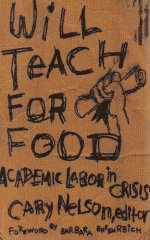
cary nelson, will work for food (book cover)We came out of the basement briefly at 3 to go over the faculty meeting, which started at 2. Cary Nelson, the President of the national AAUP and author of Will Teach for Food: Academic Labor in Crisis, has been with the team and spoke to faculty, as did Ernie Benjamin. We arrived at the end of the meeting and were greeted by heartwarming applause.

Being in a basement grinding away at this is debilitating, and moments like that really provide a shot in the arm. Thanks to all the faculty who showed up.  Similarly, at a later point in the day, I was outside the building for a minute and say faculty picketers standing in the rain getting cars to honk in support. Wonderful.

At the meeting, we noted that the university has hired an outside public relations firm from Lansing, they are paying an outside health care consultant, and there's an outside lawyer for Dykema Gosset, who has overseen negotiations since June. One faculty member made the point we've all wondering: Why don' tthey take the money they are spending on outside consulatant and use it to pay us better? Wouldn't that be more productive for all? 

The proposal that eventually came back from them was unacceptable, but we did have to note some movement. We wondered if they were trying to wrap things up by morning, even though they had announced a 10pm deadline. We countered, and got the expected lip about asking for unreasonable salary demands, etc, etc & etc. The ball is in their court and it's 3 hours until their deadline.

Ernie had a sense thay they were going to play out the clock - present something at the very last minute and if we didn't accept it or end the strike, they would try to impose it. So, we worked on having a counter-proposal to a proposal we hadn't seen. The idea was to have it ready to present, so they were walking away from our proposal, which showed movement from the previous one.

Around 9pm, we had no word from them and faculty picketrs were starting to gather outside to encourage them to keep talking.  At 9:45 they told us they had an offer. The cover sheet noted it was a best and final offer, which their lead negotiator also emphasized several times. They wanted us to call off the strike as a precondition for further negotiations. We said we're here to negotiate. They pushed on calling off the strike, but we refused until we had a fair contract, but we had a counter-offer for them to consider.

They tried to say we were out of time, but Ernie grabbed his cell phone, which said 9:55 and noted it was linked to a satellite. They were trying to find reasons not to accept it, but we had it on the table to them before 10. They refused to discuss it and walked away at 10.

We spent an hour or so with one of our lawyers, who had been following deveopments closely for months. Their move wasn't a suprise and we're prepared to the extent we can be. But this situation certainly raises the number of possible outcomes, with several days of cooling-off or a court hearing being the most likely.

I got to sleep in, which was welcome. And, I'll be heading into the office soon for meetings. But in many ways, the ball is now in the hand of the faculty overall. If they can maintain the strike and pickets, then the negotiating team can go back to work. So to the EMU faculty members, student supporters and others, it's my turn to cheer and encourage you. You're now on the front lines, not the negotiating team. Go go go.

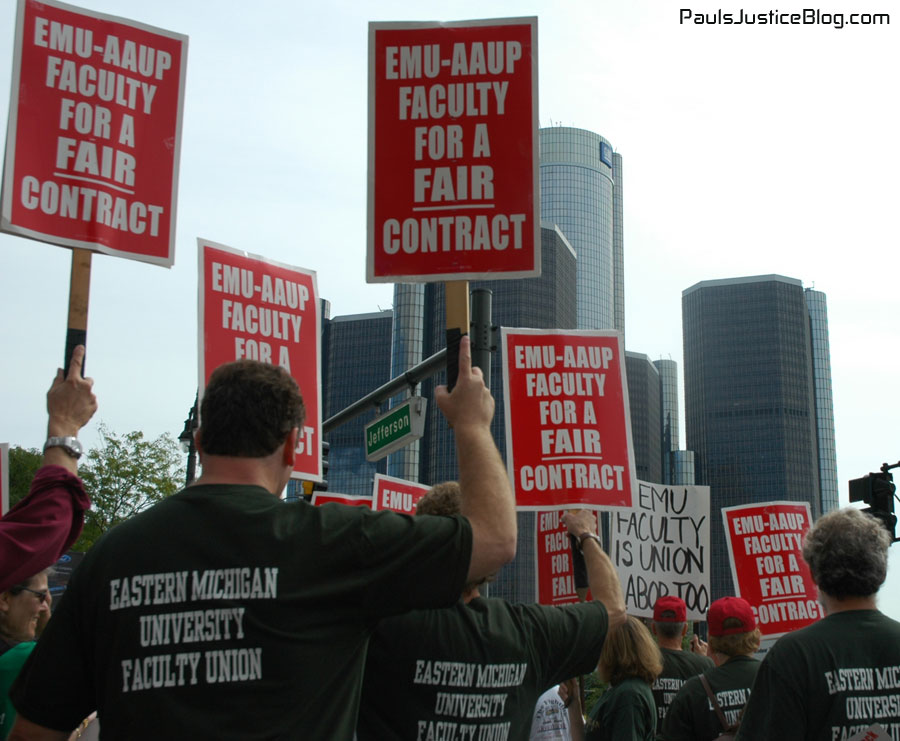
 strength in solidarity - detroit labor day parade

Start 9:15 am

Finish 11:30 pm 

More info at EMU-AAUP website. Our chief negotiator also maintains a blog with more specific information about the negotiations and issues.

« On Strike for Labor Day (Part 6) | Main | On Strike for Labor Day (Part 8) »

« On Strike for Labor Day? (Part 5) | Main | On Strike for Labor Day (Part 7) »

September 04, 2006

On Strike for Labor Day (Part 6)

 Please see On Strike for Labor Day? Part 1, Part 2, Part 3, Part 4, Part 5 and additional background

 
I've removed the question mark from the earlier posts because we are on strike and it is now labor day. The question is how long after Labor Day the strike will continue, and what will happen with the administration's threat to suspend negotiations tomorrow night. How many parts will this series have?

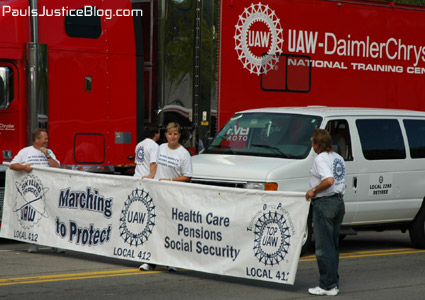
This morning, a group of us went to march in the Detroit Labor Day parade. Of course many people knew of our strike and were supportive, and I was glad to give a shout out to the Detroit teachers. As brutal as this negotiation and strike have been, theirs is even worse. I heard on the news that they have had clergy in to help build trust between the parties, and some people had been in the negotiating room for so many hours they no longer knew what day it was.

marching to protect public education and classrooms 

With unions like the UAW there, a bunch of college professors were a bit of an anomoly. But the issues of wage cuts, health care, and working conditions are universal concerns.


The team convened at 3:30 pm, and negotiations began at 5. They had a proposal for us that was a step in the right direction, but unacceptable on an absolute level.  <sarcasm> Of course we can count on inflation to moderate, so this isn't as bad as it seems </sarcasm>.

In order to make some progress, we decided to focus on health care and come to some agreement on "concepts" and a "framework."  I'll have to do some postings after the contract is ratified to fill in some of the generalities that are necessary because of the process. What is apparent to anyone reading through these entries is how much time has been spent on health care, and how strongly faculty feel about their health care (see pictures as you scroll through the other posts).

We made a counter offer on health care, and they came back with a counter-counter offer. While the first offer of theirs had some positive elements (while being unacceptable), the second one showed no movement in terms of cost to us in the first year. They moved around who would pay how much, but seem to have quickly hit a wall (again..and again and again).   

I'm sure Tues will be interesting with their threat to suspend negotiations. Will they really try to do something productive, or be provocative and try to get us to do something that would be an excuse to walk out of talks?

I noted earier that the process of negotiation combines elements of the quote about how making law and sausage are unpalatable process plus some brinksmanship. Tension certainly continues to ratchet up and today will be crazy. If I don't post anything tomorrow, it's because we're negotiating all night, or we went so late I came home and collapsed. Of course, if they walk out at 10, then I have plenty o time to do an update.

As a postscript, I did want to note that going to the Labor Day parade made me appreciate the idea of solidarity more (beyond the connection of the issues were are all struggling for that I wrote about in the previous post). I really got a sense of that, and the feeling has been extended by having Ernie Benjamin for the national AAUP with us during this last part of negotiations. He's been extemely helpful and generous with his time. Last night, the president of the national AAUP flew in. (That's probably a hint about how they expect this negotiation to go - he doesn't have time to fly to all negotiations or strikes.)

For the EMU faculty reading this, remember that there's  agood team with the support of the national AAUP and two talented labor lawyers. Other unions on campus are very supportive, as are the unions in the area. You're also now very much part of the team through the picketing and activities to make the strike effective. Your strength gives us much better bargaining position.

emu-aaup at detroit labor day parade 

Parade

Start 9am

Finish: 1pm

Negotiations

Start 3:30 pm

Finish 1am 

« On Strike for Labor Day? (Part 5) | Main | On Strike for Labor Day (Part 7) »